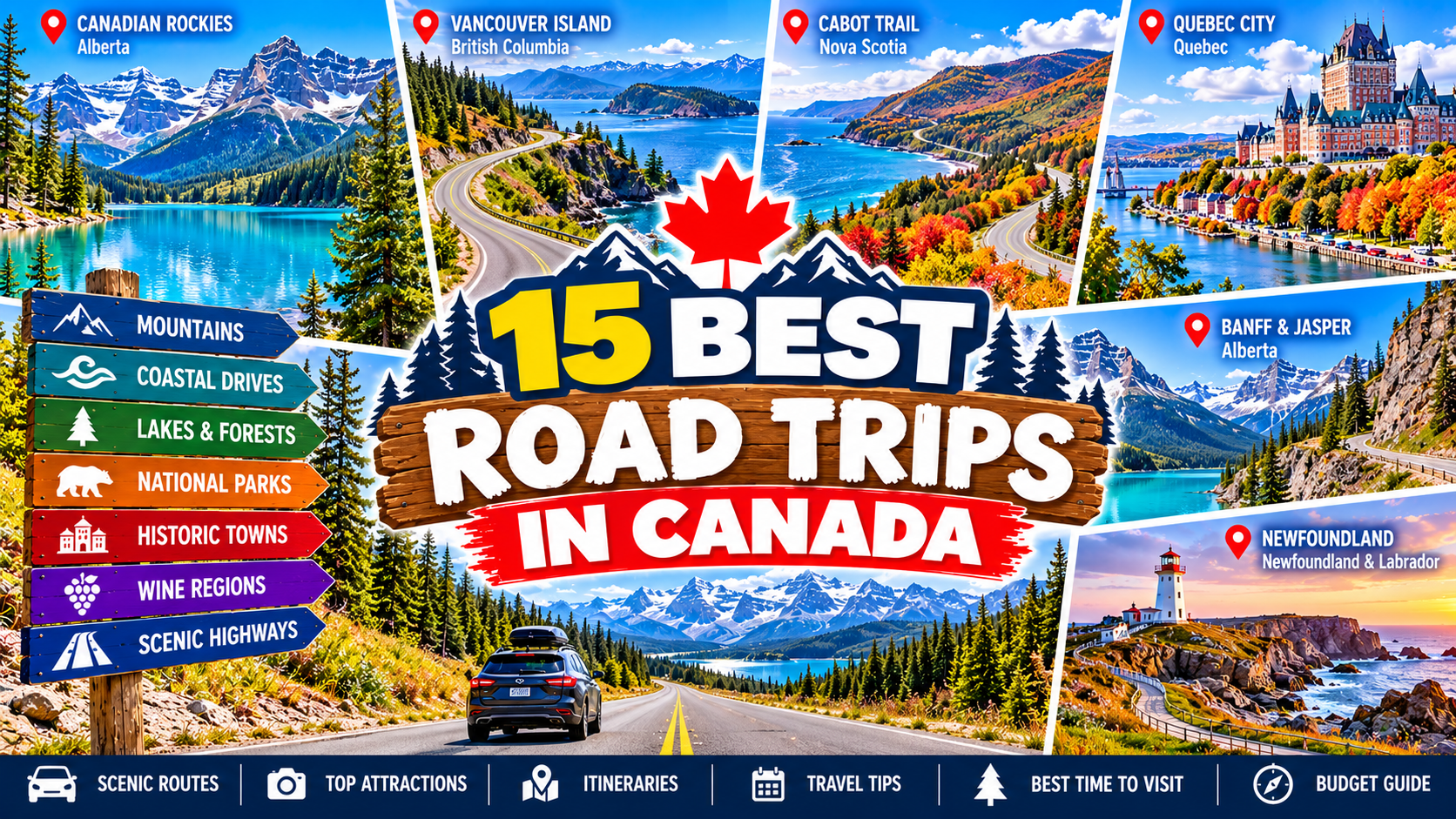
15 Best Road Trips in Canada: Scenic Routes, Itineraries & Travel Tips
Canada is one of the world’s most rewarding countries to explore by road. With towering Rocky Mountains, turquoise lakes, dramatic coastal highways, charming historic towns, and spectacular autumn forests, every province and territory offers something different.
Whether you’re dreaming of driving through Banff and Jasper, following the Pacific coastline, exploring Quebec’s historic villages, or discovering the rugged beauty of Atlantic Canada, the possibilities are almost endless.
The best road trips in Canada combine unforgettable scenery with opportunities to explore national parks, visit small towns, experience local culture, and discover places you might otherwise miss.
In this complete Canadian road trip guide, we’ll explore 15 scenic driving routes across the country, including recommended durations, approximate distances, top attractions, seasonal travel advice, estimated costs, and practical planning tips.
Quick Comparison: 15 Best Road Trips in Canada
| Road trip | Province or territory | Suggested duration | Approximate distance |
|---|---|---|---|
| Icefields Parkway | Alberta | 1–2 days | 232 km |
| Banff to Jasper Rockies Adventure | Alberta | 4–7 days | 300–500+ km |
| Vancouver to Whistler | British Columbia | 1–3 days | 120 km one way |
| Vancouver Island Coastal Road Trip | British Columbia | 4–7 days | 500–800 km |
| Okanagan Valley Wine and Lake Route | British Columbia | 3–5 days | 250–450 km |
| Calgary to Drumheller | Alberta | 1–2 days | 135 km one way |
| Toronto to Niagara Falls | Ontario | 1–2 days | 130 km one way |
| Georgian Bay and Bruce Peninsula | Ontario | 3–5 days | 500–750 km |
| Ottawa to Montreal and Quebec City | Ontario and Quebec | 4–6 days | 450–600 km |
| Quebec’s St. Lawrence River Route | Quebec | 4–7 days | 482 km for Route des Navigateurs |
| Cabot Trail | Nova Scotia | 2–4 days | 298 km loop |
| Prince Edward Island Coastal Drive | Prince Edward Island | 3–5 days | 350–600 km |
| Fundy Coastal Drive | New Brunswick | 2–4 days | 250–400 km |
| Newfoundland’s Irish Loop | Newfoundland and Labrador | 1–3 days | Approximately 300 km |
| Whitehorse to Dawson City | Yukon | 2–4 days | 525 km one way |
Distances are approximate. Some represent the principal highway or a suggested itinerary rather than a complete round trip. Detours, hotel locations, and sightseeing stops can increase total mileage.
1. Icefields Parkway: Lake Louise to Jasper, Alberta
The Icefields Parkway is among Canada’s most spectacular scenic drives.
This 232-kilometre mountain highway connects Lake Louise in Banff National Park with Jasper National Park.
Along the way, travelers experience glaciers, turquoise lakes, dramatic mountain peaks, waterfalls, and breathtaking viewpoints.
Road trip overview
- Starting point: Lake Louise.
- Ending point: Jasper.
- Distance: 232 km one way.
- Recommended duration: One full day or two relaxed days.
- Best general season: Late June to September.
- Main attractions: Peyto Lake, Bow Lake, Columbia Icefield, Sunwapta Falls, and Athabasca Falls.
Best stops along the Icefields Parkway
Bow Lake: A beautiful mountain lake surrounded by dramatic peaks.
Peyto Lake: Famous for its brilliant turquoise water and elevated viewpoint.
Mistaya Canyon: A scenic canyon with rushing water and interesting rock formations.
Columbia Icefield: One of the most impressive glacier landscapes in the Canadian Rockies.
Sunwapta Falls: A powerful waterfall surrounded by mountain scenery.
Athabasca Falls: A spectacular waterfall near Jasper.
Suggested itinerary
Morning: Depart Lake Louise and visit Bow Lake and Peyto Lake.
Midday: Explore viewpoints near the Columbia Icefield.
Afternoon: Stop at Sunwapta Falls and Athabasca Falls.
Evening: Arrive in Jasper.
Important driving information
The Icefields Parkway is remote, with limited services and long stretches without mobile phone coverage.
Fuel availability along the route is limited and seasonal.
Winter driving can be particularly challenging, and snow can occur even during warmer months.
Parks Canada requires snow tires or chains from November 1 to March 31, or whenever the parkway is covered with snow and ice.
Check official road conditions before departure.
Official resource: https://parks.canada.ca/pn-np/ab/banff/visit/promenadedesglaciers-icefieldsparkway
2. Banff to Jasper: The Ultimate Canadian Rockies Road Trip
A longer Banff-to-Jasper journey is one of the best road trips in Canada for nature lovers.
Unlike a single-day Icefields Parkway drive, this itinerary allows several days to explore mountain towns, lakes, hiking trails, and scenic viewpoints.
Road trip overview
- Starting point: Banff or Calgary.
- Ending point: Jasper.
- Recommended duration: 4–7 days.
- Suggested driving distance: Approximately 300–500+ km, depending on sightseeing.
- Best general season: June to September.
Recommended itinerary
Day 1: Explore Banff
Visit Banff town, Bow Falls, Surprise Corner, and Lake Minnewanka.
Day 2: Lake Louise and Moraine Lake
Spend time at Lake Louise and, when seasonal access is available, visit Moraine Lake using an authorized shuttle or transportation provider.
Personal vehicles are generally not permitted on Moraine Lake Road.
Day 3: Icefields Parkway
Travel toward Jasper, stopping at Bow Lake, Peyto Lake, the Columbia Icefield, and waterfalls.
Day 4: Explore Jasper
Visit accessible Jasper attractions, lakes, and scenic viewpoints.
Optional Days 5–7
Add extra hiking, wildlife viewing, photography, or relaxation.
Why choose this road trip?
This itinerary combines some of Canada’s most iconic mountain destinations into one unforgettable adventure.
Read our Canadian Rockies Road Trip Guide for additional planning information.
3. Vancouver to Whistler: Sea to Sky Highway, British Columbia
The Sea to Sky Highway is one of British Columbia’s most scenic routes.
Highway 99 connects Vancouver with Whistler, passing coastal landscapes, forests, mountains, and waterfalls.
Road trip overview
- Starting point: Vancouver.
- Ending point: Whistler.
- Distance: Approximately 120 km one way.
- Recommended duration: 1–3 days.
- Best season: Year-round, depending on activities and driving conditions.
Best stops
Horseshoe Bay: A picturesque waterfront community near Vancouver.
Shannon Falls: A spectacular waterfall near Squamish.
Sea to Sky Gondola: Offers mountain views and elevated sightseeing experiences.
Squamish: Popular for outdoor recreation and scenic mountain surroundings.
Whistler Village: Known for restaurants, mountain activities, and year-round tourism.
Suggested itinerary
Leave Vancouver in the morning.
Stop at Horseshoe Bay and Shannon Falls.
Spend time exploring Squamish.
Continue to Whistler and enjoy the village.
Stay overnight if you want more time for outdoor activities.
Travel tip
Highway 99 includes mountainous sections, and winter tire or chain requirements apply during designated periods.
Check DriveBC before traveling.
4. Vancouver Island Coastal Road Trip, British Columbia
Vancouver Island offers beautiful beaches, forests, coastal communities, and scenic highways.
This road trip is ideal for travelers who enjoy ocean views, wildlife, and relaxed coastal destinations.
Road trip overview
- Starting point: Victoria or Nanaimo.
- Recommended duration: 4–7 days.
- Suggested distance: Approximately 500–800 km.
- Best season: May to September for many outdoor activities.
Recommended destinations
Victoria: Explore the Inner Harbour, historic architecture, gardens, and waterfront.
Duncan: Discover local arts, heritage, and nearby countryside.
Parksville: Enjoy beaches and coastal scenery.
Cathedral Grove: See impressive old-growth trees where access is permitted.
Ucluelet: Explore coastal trails and ocean viewpoints.
Tofino: Famous for beaches, surfing, and Pacific Coast scenery.
Suggested five-day itinerary
Day 1: Explore Victoria.
Day 2: Travel toward Parksville and visit coastal attractions.
Day 3: Continue toward Ucluelet.
Day 4: Explore Tofino and nearby beaches.
Day 5: Return toward Nanaimo or Victoria.
Travel tip
Book ferry reservations early during peak travel periods.
Check BC Ferries and highway conditions before departure.
5. Okanagan Valley Road Trip, British Columbia
The Okanagan Valley is famous for warm summers, beautiful lakes, orchards, vineyards, and scenic towns.
This road trip offers a different experience from Canada’s mountain and coastal routes.
Road trip overview
- Starting point: Kelowna.
- Suggested route: Kelowna → Penticton → Osoyoos.
- Recommended duration: 3–5 days.
- Suggested distance: 250–450 km with local sightseeing.
- Best season: Late spring through early autumn.
Best attractions
Okanagan Lake: Enjoy waterfront walks and scenic viewpoints.
Kelowna: Explore beaches, restaurants, and lakeside parks.
Summerland: Discover orchards, historic attractions, and scenic countryside.
Penticton: Visit Okanagan Lake and Skaha Lake.
Osoyoos: Experience a distinctive dry-climate landscape and warm-weather recreation.
Suggested itinerary
Spend one day exploring Kelowna.
Travel south toward Summerland and Penticton.
Continue to Osoyoos for lakeside relaxation and sightseeing.
Why visit?
The Okanagan is excellent for couples, families, food lovers, and travelers seeking a relaxed summer road trip.
6. Calgary to Drumheller: Alberta Badlands Road Trip
Drumheller offers one of Alberta’s most unusual landscapes.
Instead of towering mountains, visitors discover colourful badlands, hoodoos, canyons, and dinosaur history.
Road trip overview
- Starting point: Calgary.
- Ending point: Drumheller.
- Distance: Approximately 135 km one way.
- Recommended duration: 1–2 days.
- Best season: May to October for comfortable outdoor sightseeing.
Best stops
Royal Tyrrell Museum: One of Canada’s leading museums dedicated to prehistoric life.
Horseshoe Canyon: Offers dramatic badlands scenery.
Hoodoos: Distinctive rock formations created by erosion.
Drumheller town: Explore dinosaur-themed attractions and local restaurants.
Horsethief Canyon: A scenic viewpoint overlooking the badlands.
One-day itinerary
Morning: Depart Calgary and visit Horseshoe Canyon.
Midday: Explore the Royal Tyrrell Museum.
Afternoon: Visit the Hoodoos and additional viewpoints.
Evening: Return to Calgary.
Travel tip
Summer temperatures in the badlands can become very hot.
Carry water, wear sun protection, and avoid hiking during extreme heat.
7. Toronto to Niagara Falls: Ontario’s Classic Road Trip
A Toronto-to-Niagara Falls road trip is ideal for first-time visitors to Ontario.
The route combines city sightseeing with one of the world’s most famous waterfall destinations.
Road trip overview
- Starting point: Toronto.
- Ending point: Niagara Falls.
- Distance: Approximately 130 km one way.
- Recommended duration: 1–2 days.
- Best season: May to October for the broadest range of seasonal attractions.
Best stops
Niagara Falls: Enjoy views of Horseshoe Falls and the Niagara River.
Journey Behind the Falls: Experience waterfall viewing areas, subject to current access arrangements.
Niagara City Cruises: Take a seasonal boat tour.
Queen Victoria Park: Enjoy gardens and waterfall viewpoints.
Niagara-on-the-Lake: Explore historic streets, cafés, and nearby vineyards.
Suggested itinerary
Leave Toronto early.
Spend the morning exploring Niagara Falls.
Enjoy a boat cruise or another major attraction.
Travel to Niagara-on-the-Lake in the afternoon.
Return to Toronto or stay overnight.
Travel tip
Traffic can be heavy on summer weekends.
Check parking arrangements and attraction schedules in advance.
Read our Niagara Falls Travel Guide for detailed sightseeing advice.
8. Georgian Bay and Bruce Peninsula Road Trip, Ontario
Ontario’s Georgian Bay region offers clear water, dramatic shorelines, forests, and beautiful coastal towns.
Road trip overview
- Starting point: Toronto.
- Suggested route: Toronto → Collingwood → Owen Sound → Tobermory.
- Recommended duration: 3–5 days.
- Suggested distance: Approximately 500–750 km including sightseeing.
- Best season: Late spring through early autumn.
Best stops
Collingwood: A scenic town near Georgian Bay.
Blue Mountain: Popular for outdoor activities and village attractions.
Owen Sound: A useful base for waterfalls and regional sightseeing.
Bruce Peninsula National Park: Known for rugged limestone scenery and turquoise water.
Tobermory: Famous for its harbour and access to boat excursions.
Suggested itinerary
Day 1: Drive from Toronto to Collingwood.
Day 2: Explore Blue Mountain and continue toward Owen Sound.
Day 3: Visit Bruce Peninsula National Park.
Day 4: Explore Tobermory.
Day 5: Return to Toronto.
Important planning tip
Popular locations in Bruce Peninsula National Park may require advance parking reservations.
Check Parks Canada before traveling.
9. Ottawa to Montreal and Quebec City: Historic Eastern Canada Road Trip
This road trip combines Canada’s capital with two of Quebec’s most famous cities.
It’s an excellent choice for travelers interested in architecture, history, museums, food, and culture.
Road trip overview
- Starting point: Ottawa.
- Ending point: Quebec City.
- Recommended duration: 4–6 days.
- Approximate direct distance: 450 km.
- Suggested total distance: 450–600 km with sightseeing.
- Best season: May to October, although winter city trips are also popular.
Recommended itinerary
Day 1: Ottawa
Visit Parliament Hill, the Rideau Canal area, and major museums.
Day 2: Ottawa to Montreal
Travel to Montreal and explore Old Montreal.
Day 3: Montreal
Visit Mount Royal, local neighbourhoods, and historic attractions.
Day 4: Montreal to Quebec City
Continue along the St. Lawrence corridor toward Quebec City.
Day 5: Quebec City
Explore Old Quebec, Château Frontenac viewpoints, and nearby attractions.
Day 6: Optional extra sightseeing
Visit Montmorency Falls or other regional destinations.
Why choose this route?
It combines three distinctive Canadian cities without requiring extremely long daily drives.
10. Quebec’s St. Lawrence River Scenic Road Trip
Quebec offers beautiful driving routes along the St. Lawrence River.
One notable option is the official Route des Navigateurs, which travels through historic river communities.
Road trip overview
- Province: Quebec.
- Route: Route des Navigateurs.
- Distance: Approximately 482 km.
- Recommended duration: 4–7 days for a selected itinerary.
- Best season: Late spring through autumn.
What makes this route special?
Travelers can explore riverside towns, maritime heritage, museums, historic sites, and scenic viewpoints.
Recommended experiences
- Visit historic river communities.
- Explore maritime museums.
- Enjoy waterfront walks.
- Discover local restaurants.
- Photograph lighthouses and river scenery.
- Take seasonal boat excursions where available.
Travel tip
The official route includes many possible attractions, so select a manageable number of stops rather than attempting to visit everything in one day.
Official resource: https://www.bonjourquebec.com/en/where-to-go/routes-and-itineraries/navigators-route
11. Cabot Trail: Cape Breton Island, Nova Scotia
The Cabot Trail is one of Canada’s most famous coastal drives.
Located on Cape Breton Island, this scenic loop features ocean cliffs, forested mountains, fishing communities, and beautiful viewpoints.
Road trip overview
- Location: Cape Breton Island, Nova Scotia.
- Distance: Approximately 298 km.
- Recommended duration: 2–4 days.
- Best season: June to October.
- Main attraction: Cape Breton Highlands National Park.
Best stops
Chéticamp: A community known for Acadian culture and coastal scenery.
Cape Breton Highlands National Park: Explore scenic drives and hiking trails.
Skyline Trail: A famous hiking destination with coastal viewpoints.
Pleasant Bay: Enjoy beautiful ocean scenery.
Ingonish: Discover beaches, forest landscapes, and mountain views.
Suggested three-day itinerary
Day 1: Begin near Baddeck and travel toward Chéticamp.
Day 2: Explore Cape Breton Highlands National Park.
Day 3: Continue through Ingonish and complete the loop.
Best time for fall colours
Late September and October are popular for autumn scenery, although peak colours vary with weather and elevation.
Travel tip
The route includes winding mountain roads and steep sections.
Allow extra time for scenic stops and changing weather.
Official tourism resource: https://novascotia.com/
12. Prince Edward Island Coastal Road Trip
Prince Edward Island is known for red-sand beaches, rolling farmland, lighthouses, and charming seaside communities.
This is an excellent road trip for travelers who enjoy relaxed coastal scenery.
Road trip overview
- Starting point: Charlottetown.
- Recommended duration: 3–5 days.
- Suggested distance: 350–600 km.
- Best season: June to September.
Best attractions
Charlottetown: Explore historic streets, restaurants, and waterfront areas.
Cavendish: Famous for beaches and connections to Anne of Green Gables.
Prince Edward Island National Park: Discover coastal landscapes and beaches.
North Rustico: A scenic fishing community.
Basin Head: Known for its beautiful beach.
Suggested itinerary
Day 1: Explore Charlottetown.
Day 2: Visit Cavendish and nearby coastal attractions.
Day 3: Explore the northern coastline.
Day 4: Discover eastern PEI.
Day 5: Return to Charlottetown.
Travel tip
Some tourism businesses operate seasonally, so check opening dates before visiting outside summer.
13. Fundy Coastal Road Trip, New Brunswick
New Brunswick’s Bay of Fundy coastline is famous for exceptionally high tides and dramatic coastal scenery.
Road trip overview
- Starting point: Saint John or Moncton.
- Recommended duration: 2–4 days.
- Suggested distance: 250–400 km.
- Best season: May to October.
Best stops
Hopewell Rocks: Famous for distinctive rock formations shaped by tidal action.
Fundy National Park: Offers forests, waterfalls, hiking trails, and coastal scenery.
Alma: A small coastal community near the national park.
Saint Martins: Known for sea caves and coastal views.
Fundy Trail Provincial Park: Offers scenic coastal driving and viewpoints.
Suggested itinerary
Day 1: Explore Saint John and Saint Martins.
Day 2: Drive through the Fundy Trail area.
Day 3: Visit Fundy National Park and Alma.
Day 4: Explore Hopewell Rocks.
Important safety tip
Tides change rapidly in the Bay of Fundy.
Always check official tide schedules and obey access restrictions when visiting beaches and sea caves.
14. Newfoundland’s Irish Loop Road Trip
Newfoundland offers rugged coastlines, fishing villages, lighthouses, and dramatic Atlantic Ocean scenery.
The Irish Loop is a popular scenic drive along the Avalon Peninsula.
Road trip overview
- Starting point: St. John’s.
- Route: Southern Avalon Peninsula.
- Recommended duration: 1–3 days.
- Approximate distance: Around 300 km for a typical loop.
- Best season: Late spring through early autumn.
Best stops
Bay Bulls: A coastal community associated with seasonal boat excursions.
Witless Bay: Known for seabird colonies and marine wildlife.
Ferryland: Offers historic attractions and coastal scenery.
Cape Race area: Known for remote coastal landscapes.
Trepassey: A small community with scenic surroundings.
Suggested itinerary
Start in St. John’s.
Travel south toward Bay Bulls and Witless Bay.
Continue to Ferryland and explore coastal attractions.
Extend the journey toward the southern Avalon Peninsula if time permits.
Return to St. John’s.
Travel tip
Fog, strong winds, and changing coastal weather can affect driving conditions.
Check local forecasts and fuel availability.
15. Whitehorse to Dawson City: Yukon Klondike Road Trip
The Yukon offers a completely different Canadian road trip experience.
Traveling from Whitehorse to Dawson City takes you through northern landscapes, historic communities, forests, and remote highways.
Road trip overview
- Starting point: Whitehorse.
- Ending point: Dawson City.
- Distance: Approximately 525 km one way.
- Recommended duration: 2–4 days.
- Best general season: June to September.
Best attractions
Whitehorse: Explore Yukon’s capital and local heritage attractions.
Klondike Highway: Enjoy expansive northern scenery.
Five Finger Rapids viewpoint: A scenic stop along the route.
Dawson City: Discover Gold Rush history and historic buildings.
Klondike National Historic Sites: Learn about the region’s gold-mining heritage.
Suggested itinerary
Day 1: Explore Whitehorse and prepare for the drive.
Day 2: Travel toward Dawson City with scenic stops.
Day 3: Explore Dawson City and its historic attractions.
Day 4: Begin your return journey or continue exploring the region.
Important safety information
Fuel stations, accommodation, and mobile coverage can be limited along northern highways.
Plan fuel stops, download offline maps, and carry emergency supplies.
Official resource: https://parks.canada.ca/lhn-nhs/yt/klondike
Best Road Trips in Canada by Travel Style
Different road trips suit different interests.
Best for mountain scenery
- Icefields Parkway.
- Banff to Jasper.
- Vancouver to Whistler.
Best for coastal scenery
- Cabot Trail.
- Vancouver Island.
- Prince Edward Island.
- Newfoundland’s Irish Loop.
Best for families
- Calgary to Drumheller.
- Toronto to Niagara Falls.
- Prince Edward Island.
- Ottawa to Montreal and Quebec City.
Best for autumn colours
- Cabot Trail.
- Quebec’s St. Lawrence River route.
- Georgian Bay and Bruce Peninsula.
Best for adventure
- Yukon Klondike Highway.
- Icefields Parkway.
- Vancouver Island.
Best Time for a Canadian Road Trip
Canada’s seasons create very different driving experiences.
Spring: April to May
Spring is suitable for some lower-elevation routes, cities, and coastal regions.
Mountain roads may still experience winter conditions.
Summer: June to August
Summer is generally the most popular season for Canadian road trips.
Advantages include longer daylight hours and wider availability of seasonal attractions.
However, accommodations can be expensive, and popular destinations may be crowded.
Autumn: September to October
Autumn is excellent for colourful landscapes, cooler temperatures, and scenic photography.
Eastern Canada is especially popular for fall foliage.
Winter: November to March
Winter road trips require more preparation.
Snow, ice, extreme cold, and reduced daylight can create dangerous driving conditions.
Some seasonal roads and attractions may close.
For practical cold-weather advice, read Canadian Winter Survival Tips for Newcomers.
How Much Does a Road Trip in Canada Cost?
Road trip expenses depend on travel distance, vehicle type, fuel prices, accommodation, food, and activities.
The following estimates are illustrative planning figures in Canadian dollars, not live quotes.
Estimated daily road trip budget for two adults
| Expense | Budget estimate (CAD) |
|---|---|
| Fuel | $35–$90 |
| Accommodation | $120–$250 |
| Meals | $60–$120 |
| Parking and attractions | $20–$80 |
| Miscellaneous | $15–$40 |
| Estimated daily total | $250–$580 |
These estimates assume use of an already available vehicle and exclude vehicle rental, major repairs, and long-distance flights.
Estimated five-day road trip budget
For two adults:
- Lower-budget example: CAD $1,250.
- Mid-range example: CAD $1,900.
- Higher-budget example: CAD $2,900.
Actual costs can be higher in peak-season mountain destinations and remote areas.
Ways to reduce road trip expenses
- Travel outside peak holiday periods.
- Book accommodation in advance.
- Choose reasonably priced hotels or campgrounds.
- Prepare some meals yourself.
- Combine nearby attractions.
- Avoid unnecessary detours.
- Compare fuel prices.
- Use free viewpoints and public parks.
- Plan realistic daily driving distances.
For more budgeting advice, visit our Canada Travel Budget Guide.
Essential Canadian Road Trip Packing List
Before starting a road trip, prepare the following essentials.
Vehicle essentials
- Valid driver’s licence.
- Vehicle registration and insurance.
- Spare tire or appropriate tire repair equipment.
- Tire pressure gauge.
- Windshield washer fluid.
- Phone charger.
- Emergency warning equipment.
- First-aid kit.
- Appropriate seasonal tires.
Personal essentials
- Weather-appropriate clothing.
- Comfortable walking shoes.
- Water.
- Snacks.
- Sunscreen.
- Sunglasses.
- Personal medications.
- Reusable water bottles.
- Travel documents.
Navigation and safety
- Offline maps.
- Planned fuel stops.
- Accommodation confirmations.
- Emergency contact information.
- Weather forecast.
- Provincial road condition websites.
Winter additions
- Warm blankets.
- Gloves and hats.
- Snow brush and ice scraper.
- Small shovel.
- Traction material.
- Extra food and water.
- Suitable emergency supplies.
10 Important Canadian Road Trip Planning Tips
1. Avoid driving too many hours every day
Allow enough time for sightseeing, meals, rest, and unexpected delays.
2. Check road conditions before departure
Use official provincial road information services.
3. Download offline maps
Remote regions may have limited mobile coverage.
4. Plan fuel stops
This is especially important in northern Canada and remote mountain areas.
5. Book accommodation early
Popular summer destinations can sell out.
6. Understand national park admission
Some attractions and national parks require admission fees, parking reservations, or shuttle bookings.
7. Respect wildlife
Never feed wildlife or stop unsafely on highways to take photographs.
8. Prepare for changing weather
Mountain weather can change rapidly.
9. Take regular breaks
Fatigue increases driving risk.
10. Keep your itinerary flexible
Allow time for road closures, weather changes, and unexpected discoveries.
Frequently Asked Questions About Road Trips in Canada
What is the best road trip in Canada?
The Icefields Parkway and Banff-to-Jasper route are among the most famous choices for mountain scenery. The Cabot Trail is especially popular for coastal landscapes.
What is the most scenic drive in Canada?
The Icefields Parkway is widely recognized for its dramatic Rocky Mountain scenery, glaciers, and turquoise lakes.
How many days do you need for a Canadian road trip?
A short road trip may take one or two days, while regional journeys often benefit from four to seven days or longer.
Can you road trip across Canada in two weeks?
It is possible to cover substantial distances, but a coast-to-coast trip in two weeks would involve long driving days and limited sightseeing time. A longer trip or a regional itinerary is usually more enjoyable.
What is the best month for road trips in Canada?
June through September is generally popular for many routes, while September and October are excellent for autumn scenery in some regions.
Is Canada safe for road trips?
Canada has an extensive road network, but driving risks vary by weather, road conditions, wildlife, remoteness, and driver experience.
Do I need an SUV for Canadian road trips?
Not necessarily. Many popular routes are paved and accessible to ordinary passenger vehicles in suitable conditions.
Can I rent a car for a Canadian road trip?
Yes. Rental vehicles are widely available in major cities and airports. Confirm insurance, mileage limits, additional-driver policies, and one-way fees.
Are Canadian national parks free to enter?
Not always. Admission fees and other charges may apply. Check current Parks Canada information.
Which Canadian road trip is best for families?
Toronto to Niagara Falls, Calgary to Drumheller, Prince Edward Island, and shorter Canadian Rockies itineraries can be good choices.
What is the best coastal road trip in Canada?
The Cabot Trail, Vancouver Island, and Newfoundland’s Irish Loop are excellent coastal options.
What should I do if a road is closed?
Follow official road closure notices and use authorized alternate routes. Never bypass closure signs.
Final Thoughts: Discover Canada One Road Trip at a Time
Canada offers some of the world’s most unforgettable road trip experiences.
From the turquoise lakes of the Canadian Rockies to the dramatic Atlantic coastline, historic Quebec towns, beautiful British Columbia highways, and the remote landscapes of the Yukon, every region has its own story.
If you’re planning your first Canadian road trip, start with a manageable route such as Calgary to Drumheller, Vancouver to Whistler, or Toronto to Niagara Falls.
For travelers seeking longer adventures, the Icefields Parkway, Cabot Trail, Vancouver Island, and Banff-to-Jasper routes offer extraordinary scenery.
The secret to a memorable road trip is not driving the greatest distance. It’s allowing enough time to enjoy the places along the way.
Plan carefully, travel safely, respect nature, and discover the beauty of Canada at your own pace.
Continue exploring on Explore Canada Daily:
- Canadian Rockies Road Trip Guide
- 15 Best Places to Visit in Banff National Park
- Niagara Falls Travel Guide
- Vancouver Travel Guide
- 15 Best National Parks in Canada
- Canada Travel Budget Guide
- Best Time to Visit Canada
Official travel planning resources:
- Parks Canada
- 511 Alberta
- DriveBC
- Destination Ontario
- Bonjour Québec
- Tourism Nova Scotia
- Tourism PEI
- Tourism New Brunswick
- Newfoundland and Labrador Tourism
- Travel Yukon
Disclaimer: Driving distances, road conditions, attraction access, fuel availability, accommodation prices, and seasonal requirements may change. Always check official sources and current conditions before traveling.