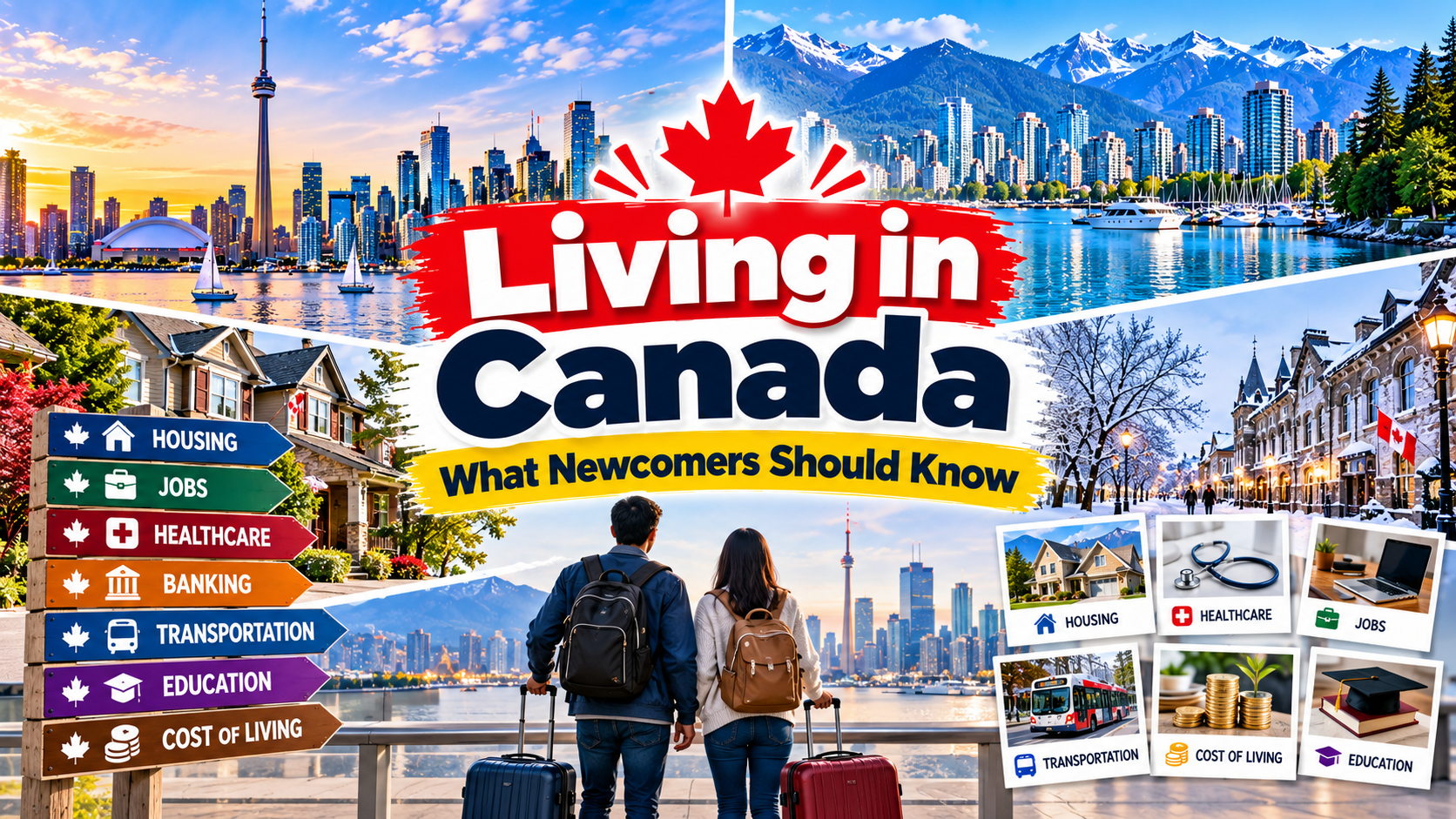
Living in Canada: What Newcomers Should Know — Complete Guide
Moving to Canada is an exciting opportunity to build a new life, explore different cultures, develop a career, and experience one of the world’s most geographically diverse countries.
However, settling in a new country also brings challenges. Finding accommodation, understanding healthcare, opening a bank account, searching for employment, and adjusting to Canadian weather can feel overwhelming during the first few months.
Whether you’re arriving as a permanent resident, international student, temporary foreign worker, or accompanying family member, understanding everyday life in Canada can help you prepare.
This living in Canada guide for newcomers explains 20 essential things you should know, including the cost of living, housing, jobs, education, transportation, banking, taxes, winter weather, and Canadian culture.
You’ll also find a practical first-month checklist and answers to frequently asked questions.
1. Canada Is a Large and Diverse Country
One of the first things newcomers should understand is Canada’s enormous geographical size.
Canada has ten provinces and three territories, and everyday life can differ significantly between regions.
For example:
- Toronto, Ontario: A large multicultural city with extensive employment opportunities and public transportation.
- Vancouver, British Columbia: Known for its coastal scenery, comparatively mild winters, and high housing costs.
- Calgary, Alberta: Offers access to the Rocky Mountains and a mix of urban and outdoor lifestyles.
- Edmonton, Alberta: Known for its river valley, festivals, long winters, and diverse communities.
- Montreal, Quebec: A culturally rich city where French plays a central role in everyday life.
- Halifax, Nova Scotia: A coastal city with maritime culture and a growing urban community.
- Winnipeg, Manitoba: A prairie city with distinct seasons and a relatively compact urban layout.
Choosing where to live depends on employment, housing costs, language, family needs, transportation, and personal preferences.
Newcomer tip: Research the city and neighbourhood, not just the province, before choosing your new home.
2. Understand Your Immigration Status and Conditions
Your immigration status determines which activities you may legally undertake in Canada.
Common newcomer categories include permanent residents, temporary foreign workers, international students, and accompanying family members.
Permanent residents
Permanent residents generally have the right to live, work, and study in Canada, subject to applicable laws and requirements.
Work permit holders
A work permit may be employer-specific or open.
An employer-specific permit normally restricts employment according to the conditions printed on the permit.
An open work permit may allow employment with many Canadian employers, subject to restrictions.
International students
Study permit holders must follow the conditions of their permits, including applicable work restrictions.
Important documents
Keep secure copies of:
- Passport.
- Immigration documents.
- Work or study permit, if applicable.
- Confirmation of permanent residence or PR card, if applicable.
- Educational certificates.
- Employment references.
- Marriage or birth certificates when relevant.
- Medical and vaccination records.
Always verify current immigration conditions through Immigration, Refugees and Citizenship Canada.
3. Apply for a Social Insurance Number (SIN)
A Social Insurance Number, commonly called a SIN, is a nine-digit number used for employment and certain government programs.
People who are eligible to work in Canada generally need a SIN.
How to apply
- Check your eligibility.
- Prepare the required identification and immigration documents.
- Apply through Service Canada using an available application method.
- Keep your SIN confirmation securely.
Protect your SIN
Your SIN is confidential.
Do not share it casually with strangers, landlords, or businesses that do not have a legitimate reason to request it.
Official information: Social Insurance Number — Government of Canada.
4. Finding a Place to Live in Canada
Housing is one of the most important decisions when settling in Canada.
Newcomers can choose from apartments, basement suites, shared houses, condominiums, townhouses, and detached homes.
Common housing options
Shared accommodation: Renting a bedroom while sharing a kitchen and other facilities.
Apartment: A private residential unit within a larger building.
Basement suite: A residential unit located in the lower level of a house.
Condominium: A privately owned unit that may be available for rent.
Detached house: A separate house that may suit larger households.
What to check before renting
- Monthly rent.
- Security deposit and other permitted charges.
- Whether heating, electricity, and water are included.
- Internet availability.
- Parking.
- Laundry facilities.
- Public transportation access.
- Lease duration.
- Tenant insurance requirements.
- Maintenance responsibilities.
Rental laws differ between provinces and territories.
For example, deposit limits, rent increases, notice periods, and landlord entry requirements are not identical across Canada.
Read your lease carefully and learn the rules in your province.
Avoid rental scams
Be cautious if someone asks for a deposit before you have verified the property or landlord.
Never assume an online advertisement is legitimate simply because it includes photographs.
Government housing guidance: Housing in Canada for Newcomers.
5. Understanding the Cost of Living in Canada
The cost of living varies considerably depending on your city, housing situation, household size, and lifestyle.
Housing is often the largest monthly expense.
Illustrative monthly budget for one adult
| Expense | Estimated monthly cost (CAD) |
|---|---|
| Shared accommodation | $700–$1,200 |
| Groceries | $300–$500 |
| Public transportation | $90–$170 |
| Mobile phone | $35–$80 |
| Personal and household items | $100–$200 |
| Entertainment and miscellaneous | $100–$250 |
| Estimated monthly total | $1,325–$2,400 |
These are broad planning estimates, not verified current market rates. Actual costs can be substantially higher, particularly in expensive cities or when renting a private apartment.
The table does not include every possible expense, such as childcare, insurance, tuition, debt payments, or a vehicle.
Ways to manage your budget
- Compare housing prices before relocating.
- Shop at grocery stores offering competitive prices.
- Cook meals at home.
- Use public transportation when practical.
- Avoid unnecessary subscriptions.
- Build an emergency fund.
- Track your monthly spending.
For additional budgeting ideas, explore our Canada Travel Budget Guide.
6. Opening a Canadian Bank Account
Opening a bank account is an important step toward managing everyday finances.
Canada has major banks, credit unions, and online financial institutions.
Common bank account types
Chequing account: Used for everyday purchases, bill payments, and receiving wages.
Savings account: Used for setting aside money.
Credit card: Allows eligible customers to borrow up to an approved limit and build a Canadian credit history.
What to compare
- Monthly account fees.
- Transaction limits.
- ATM access.
- International transfer charges.
- Debit card services.
- Online banking.
- Newcomer banking offers.
Some financial institutions provide special banking packages for eligible newcomers.
Check identification requirements and account terms before applying.
7. Building Your Canadian Credit History
Your credit history can affect access to loans, credit cards, and certain housing applications.
Newcomers may arrive with an established credit history from another country, but Canadian lenders may not use that history in the same way.
How to build credit responsibly
- Consider a suitable credit card if eligible.
- Make payments on time.
- Avoid carrying unnecessarily high balances.
- Keep borrowing manageable.
- Review your credit report for errors.
- Avoid applying for many credit products without a clear need.
Paying your full credit card statement balance by its due date can help you avoid interest on eligible purchases.
Important: You do not need to pay interest to build a positive credit history.
Official information: Financial Consumer Agency of Canada.
8. Understanding Healthcare in Canada
Canada has publicly funded provincial and territorial healthcare systems.
However, eligibility, enrollment procedures, coverage, and waiting periods vary by province, territory, and immigration status.
Not every newcomer automatically receives public healthcare coverage upon arrival.
Steps to take
- Check the health insurance eligibility rules in your province.
- Apply for a health card when eligible.
- Ask whether a waiting period applies.
- Arrange suitable private insurance if necessary.
- Learn where to find clinics, pharmacies, and emergency care.
What may not be fully covered
Depending on your province, eligibility, and age, some services may require separate coverage or payment.
Examples include:
- Routine dental care.
- Prescription medications outside hospitals.
- Vision services.
- Physiotherapy.
- Certain medical devices.
Employer benefit plans or private insurance may help cover eligible costs.
Family doctors and walk-in clinics
A family doctor can provide ongoing primary care.
Finding a family doctor may take time in some communities.
Walk-in clinics and other primary care services may be available, depending on local access.
Emergency tip: Call 911 for life-threatening emergencies.
For non-emergency medical advice, check your province’s available health information services.
9. Finding a Job in Canada
Finding employment is a major priority for many newcomers.
Canada offers opportunities in industries such as:
- Information technology.
- Healthcare.
- Construction.
- Transportation and logistics.
- Hospitality.
- Retail.
- Finance.
- Manufacturing.
- Education.
- Skilled trades.
Employment opportunities and licensing requirements vary by province and occupation.
How to search for jobs
Use legitimate job boards, employer career websites, networking events, and government employment resources.
Popular job-search channels include:
- Government of Canada Job Bank.
- LinkedIn.
- Employer career websites.
- Local recruitment agencies.
- Community employment centres.
Canadian-style resumes
A Canadian resume typically emphasizes:
- Relevant experience.
- Skills and qualifications.
- Achievements.
- Education and certifications.
- Clear contact information.
Avoid including unnecessary personal details such as photographs, marital status, or date of birth.
Credential recognition
Some professions are regulated and require provincial or territorial licensing.
Foreign educational credentials may need assessment, but an assessment does not automatically provide professional licensing.
Job search tip
Tailor your resume to each role and use clear examples of your experience.
Official resource: Canada Job Bank.
10. Know Your Employment Rights
Employment standards vary across Canada.
Many workers are covered by provincial or territorial employment laws, while certain industries are federally regulated.
Employment rules may cover:
- Minimum wages.
- Working hours.
- Overtime.
- Vacation pay.
- Statutory holidays.
- Workplace safety.
- Termination and notice.
- Protection against workplace harassment.
Your employer should explain your compensation and working conditions.
Keep copies of your employment agreement, pay statements, and relevant work records.
If you believe your employment rights are being violated, contact the appropriate employment standards authority.
11. Understanding Taxes in Canada
Canada has federal and provincial or territorial tax systems.
Most employees have income tax and certain other deductions withheld from their pay.
Common payroll deductions
Depending on the employment situation, deductions may include:
- Federal income tax.
- Provincial or territorial income tax.
- Canada Pension Plan or Quebec Pension Plan contributions.
- Employment Insurance premiums.
Filing an income tax return
Your tax obligations depend on your residency status for tax purposes and your circumstances.
The Canadian tax year generally runs from January 1 to December 31.
For many individuals, the income tax filing deadline is April 30 of the following year. Different rules and deadlines can apply in certain circumstances.
Benefits and credits
Eligible newcomers may qualify for government benefits or credits, depending on their circumstances.
Some programs require separate applications.
Important: Immigration status and tax residency are not the same thing.
Official resource: CRA Information for Newcomers.
12. Transportation in Canada
Transportation options depend heavily on where you live.
Public transportation
Large cities may offer buses, subways, commuter trains, or light rail.
Examples include:
- Toronto’s TTC.
- Vancouver’s TransLink network.
- Montreal’s STM.
- Calgary Transit.
- Edmonton Transit Service.
Public transportation can reduce the cost of commuting.
Driving in Canada
A vehicle may be useful in suburban areas, smaller communities, and regions with limited public transportation.
Driver’s licence requirements
Each province and territory has its own licensing rules.
Newcomers may be able to use a foreign driver’s licence temporarily, exchange an eligible licence, or complete testing.
Requirements depend on your previous licence, driving history, and province.
Vehicle expenses
Remember to budget for:
- Car payments, if applicable.
- Insurance.
- Fuel.
- Maintenance.
- Parking.
- Registration.
- Seasonal tires where appropriate.
13. Canadian Weather and Winter Survival
Canada experiences a wide variety of climates.
Winters in some regions can be extremely cold, while coastal areas may have milder but wetter conditions.
What to expect
Winter: Snow, freezing temperatures, ice, and shorter daylight hours in many regions.
Spring: Changing temperatures, rain, and melting snow.
Summer: Warm or hot weather, depending on location.
Autumn: Cooler temperatures and colourful foliage.
Essential winter clothing
- Insulated winter jacket.
- Warm boots with good traction.
- Gloves or mittens.
- Winter hat.
- Thermal layers.
- Warm socks.
- Scarf or neck warmer.
Winter safety tips
Walk carefully on icy sidewalks.
Check weather forecasts before traveling.
Dress in layers when spending time outdoors.
If you drive, prepare your vehicle for winter conditions and carry appropriate emergency supplies.
Newcomer tip: Winter temperatures vary significantly between Vancouver, Toronto, Montreal, Calgary, Edmonton, and Winnipeg. Buy clothing suited to your local climate.
14. Education and Schools in Canada
Canada has public and private educational institutions.
School systems are managed primarily by provincial and territorial governments.
Elementary and secondary education
Children may be eligible to attend publicly funded schools, but eligibility and documentation requirements vary according to province and immigration status.
Post-secondary education
Canada has universities, colleges, polytechnics, and other educational institutions.
International student tuition can be significantly higher than domestic tuition.
Registering children for school
Parents may need:
- Proof of address.
- Child’s identification.
- Immigration documents.
- Previous school records.
- Vaccination information, where required.
Contact the local school board for enrollment details.
15. Childcare and Family Life
Families moving to Canada should research childcare availability before arriving.
Childcare options may include:
- Licensed daycare centres.
- Home-based childcare.
- Preschool programs.
- Before- and after-school programs.
Costs and availability vary by location, age group, provider, and applicable government funding arrangements.
Waiting lists can be lengthy in some communities.
Family-friendly activities
Canadian communities often offer:
- Public libraries.
- Recreation centres.
- Playgrounds.
- Community festivals.
- Sports programs.
- Walking and cycling trails.
- Seasonal outdoor activities.
Local libraries are particularly useful because many provide free access to books, digital resources, programs, and community information.
16. Canadian Culture and Everyday Etiquette
Canada is a multicultural country with people from many backgrounds.
English and French are Canada’s official languages at the federal level, although language use varies by region.
Common everyday practices
Punctuality: Arriving on time is generally appreciated for appointments, interviews, and work.
Queuing: People are usually expected to wait their turn.
Personal space: Respecting personal boundaries is important.
Politeness: Expressions such as “please,” “thank you,” and “excuse me” are common.
Workplace communication: Clear, respectful communication is generally valued.
Tipping
Tipping is customary in many sit-down restaurants and certain personal services, but practices vary.
Cultural diversity
Canada has many cultural communities, festivals, places of worship, and international food options.
Newcomers can often find community organizations connected to their language, culture, or interests.
17. Learning English or French
Language skills can help with employment, education, services, and social connections.
Depending on eligibility, newcomers may have access to publicly funded language classes.
Ways to improve language skills
- Attend language classes.
- Practice everyday conversations.
- Join community activities.
- Read local news.
- Use public library resources.
- Volunteer where eligible.
- Participate in conversation groups.
Some settlement organizations also offer language assessments and referrals.
18. Free Newcomer Settlement Services
Canada has organizations that help eligible newcomers settle into their communities.
Services may include:
- Orientation to Canadian life.
- Employment support.
- Language classes.
- Housing information.
- School enrollment guidance.
- Community referrals.
- Financial literacy workshops.
Eligibility depends on the program and immigration status.
Some services are available before arrival.
Find official services through Government of Canada Newcomer Services.
19. Common Challenges Newcomers Face
Adjusting to a new country takes time.
Some common challenges include:
Finding the first job
You may need time to understand local hiring practices, professional licensing, and employer expectations.
Housing affordability
Rent can consume a significant portion of monthly income.
Winter adjustment
Cold weather, snow, and shorter days can require lifestyle changes.
Social isolation
Being far from family and friends can be difficult.
Understanding government systems
Immigration rules, taxes, healthcare, and provincial services can seem complicated at first.
Practical ways to adjust
- Connect with local community groups.
- Visit public libraries.
- Attend newcomer orientation sessions.
- Participate in recreation programs.
- Build a realistic monthly budget.
- Seek help when needed.
- Stay connected with family and friends.
Settling successfully does not require understanding everything immediately. Focus on the most important tasks first.
20. Enjoying Life in Canada
Living in Canada is not only about employment and financial responsibilities.
It also offers opportunities to explore natural landscapes, experience local festivals, discover different communities, and enjoy outdoor activities.
Popular experiences
Visit national parks: Explore mountains, forests, lakes, and coastlines.
Discover local festivals: Many cities host cultural, food, music, and seasonal celebrations.
Explore public parks: Enjoy walking, cycling, and outdoor recreation.
Try Canadian food: Discover regional dishes and international cuisines.
Take weekend trips: Explore nearby towns, provincial parks, and scenic destinations.
Experience seasonal activities: Enjoy summer hiking, autumn colours, winter skating, and spring festivals.
For inspiration, read our 15 Best National Parks in Canada.
First 30 Days in Canada: Newcomer Checklist
Use this checklist to organize your first month.
First week
- Confirm your immigration documents and permit conditions.
- Arrange temporary or permanent accommodation.
- Apply for a SIN if eligible.
- Set up a phone connection.
- Explore local transportation.
- Learn emergency contact information.
- Contact a newcomer settlement organization.
Second week
- Open a suitable bank account.
- Apply for provincial or territorial healthcare coverage if eligible.
- Research employment opportunities.
- Prepare a Canadian-style resume.
- Compare long-term housing options.
- Learn about your neighbourhood.
Third week
- Attend job interviews or career workshops.
- Explore language classes if needed.
- Research driver’s licence requirements.
- Set up household services.
- Learn local recycling and waste collection rules.
- Connect with community organizations.
Fourth week
- Review your monthly budget.
- Organize your important documents.
- Research tax obligations.
- Learn about available benefits and credits.
- Register children for school or childcare if applicable.
- Explore local parks and attractions.
- Make a plan for the next three months.
The exact order depends on your immigration status, family needs, and province.
Frequently Asked Questions About Living in Canada
Is Canada a good country for newcomers?
Canada offers educational opportunities, diverse communities, public services, and employment possibilities. However, housing costs, job competition, weather, and settlement challenges should be considered carefully.
How much money do I need to live in Canada?
The amount depends on your city, family size, and lifestyle. Housing is usually one of the largest expenses, so research local rental prices before moving.
Can newcomers get free healthcare in Canada?
Eligible residents may receive publicly funded provincial or territorial healthcare coverage. Eligibility, enrollment rules, waiting periods, and covered services vary.
Is it difficult to find a job in Canada?
Job-search difficulty depends on your skills, experience, language abilities, location, immigration status, and the labour market.
Do I need Canadian work experience to get a job?
Not every employer requires Canadian work experience. Relevant international experience and transferable skills can be valuable.
Can international students work in Canada?
Some international students may work if they meet the applicable immigration requirements and permit conditions. Always check current IRCC rules.
Is Canadian winter difficult?
Winter can be challenging in colder regions, especially for newcomers from warmer climates. Proper clothing, transportation planning, and winter safety awareness can help.
Can newcomers open a bank account without Canadian credit history?
Many financial institutions offer accounts to eligible newcomers who do not yet have Canadian credit history. Identification and account requirements vary.
Are public schools free for newcomers’ children?
Many eligible children can attend publicly funded schools without tuition, but eligibility depends on provincial rules and the family’s immigration circumstances.
Which Canadian city is best for newcomers?
There is no single best city. Toronto, Vancouver, Calgary, Edmonton, Montreal, Ottawa, and Halifax offer different combinations of employment, housing, transportation, language, and lifestyle.
What should I do immediately after arriving in Canada?
Prioritize your immigration documents, accommodation, SIN if eligible, banking, healthcare eligibility, and transportation arrangements.
Are there free settlement services for newcomers?
Yes. Government-funded and community organizations provide various settlement services to eligible newcomers.
Final Thoughts: Starting a New Life in Canada
Moving to Canada is a major life decision, and preparing in advance can make the transition easier.
Understanding housing, employment, healthcare, banking, taxes, transportation, and everyday cultural expectations will help you make informed choices.
Your first few months may involve challenges, but you can build confidence by focusing on practical priorities and using reliable community resources.
Remember that every newcomer experience is different. Your immigration status, province, family circumstances, finances, and career goals will influence the steps you need to take.
Take time to explore your community, develop new connections, and enjoy the experiences that make living in Canada unique.
Continue exploring Canada:
- 25 Best Places to Visit in Canada
- Best Time to Visit Canada
- 20 Free Things to Do in Canada
- Canada Travel Budget Guide
- 15 Best National Parks in Canada
- First-Time Visitor’s Guide to Canada
Official resources for newcomers:
- Immigration, Refugees and Citizenship Canada
- Government of Canada Newcomer Services
- Service Canada
- Canada Revenue Agency
- Canada Job Bank
- Financial Consumer Agency of Canada
Disclaimer: This article provides general settlement and lifestyle information, not individualized immigration, legal, tax, medical, or financial advice. Rules, eligibility, costs, and government programs may change. Always verify requirements with official federal, provincial, or territorial authorities.