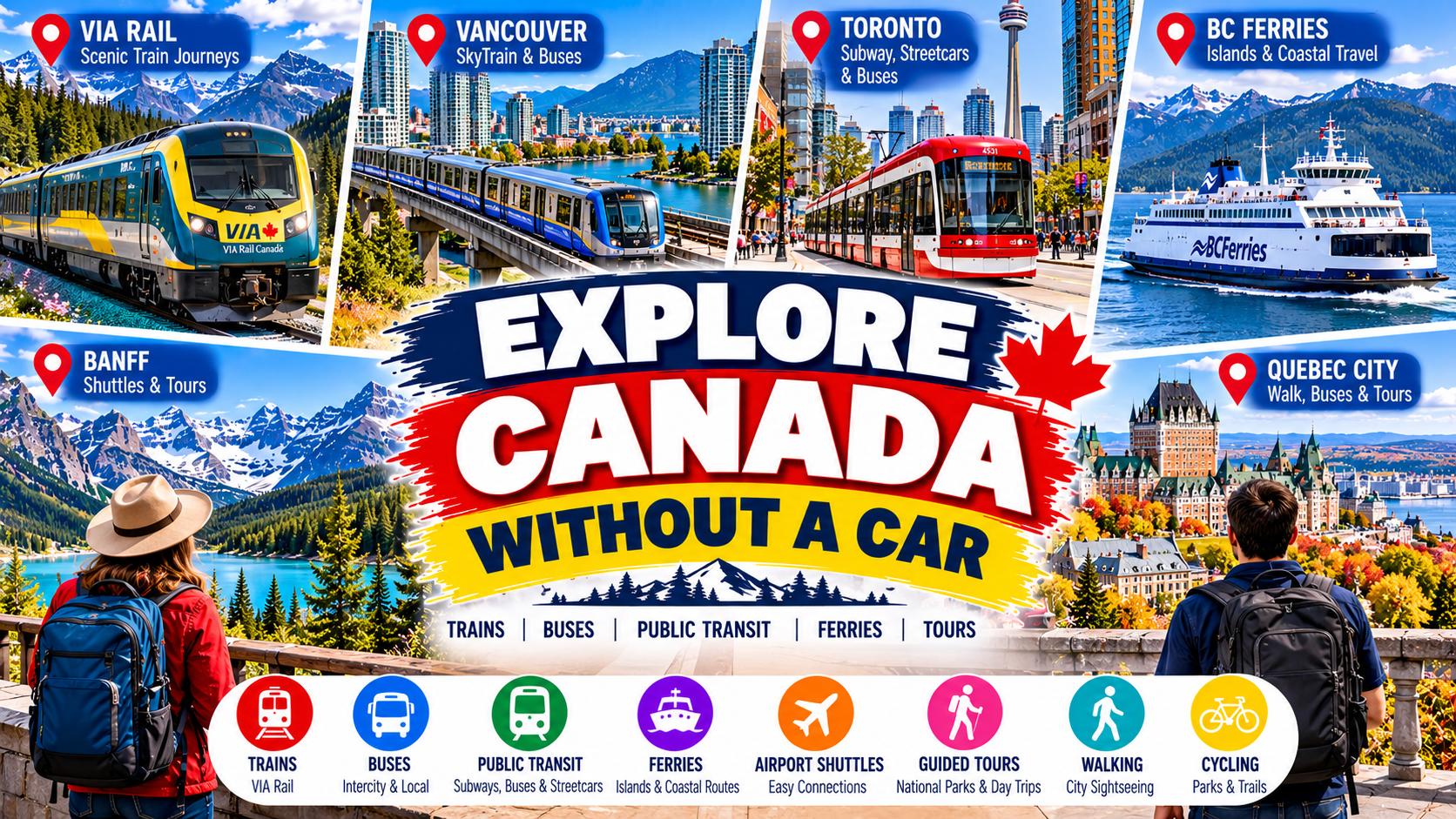
How to Explore Canada Without a Car: Complete Travel Guide
Dreaming of exploring Canada but don’t want to rent a car? Good news: you can visit many of Canada’s most exciting cities, famous attractions, national parks, and scenic destinations without driving.
From Vancouver’s SkyTrain and Toronto’s subway to VIA Rail journeys, intercity buses, ferries, and mountain shuttles, there are several ways to travel across Canada without a personal vehicle.
However, exploring Canada without a car requires careful planning. Canada is a huge country, and public transportation varies significantly between major cities, small towns, and remote destinations.
The good news is that popular destinations such as Toronto, Montreal, Vancouver, Ottawa, Quebec City, Victoria, and Banff can be explored using combinations of public transportation, walking, and organized tours.
In this complete guide, you’ll discover how to explore Canada without a car, the best transportation options, car-free destinations, sample itineraries, estimated costs, and practical travel tips.
Can You Really Travel Around Canada Without a Car?
Yes, you can travel around many parts of Canada without a car.
The easiest destinations are usually major cities with established public transportation networks.
Traveling between selected cities is also possible by train, bus, or plane.
Some popular national park attractions have dedicated shuttle services, while ferries provide connections to coastal communities and islands.
However, traveling without a car becomes more challenging in rural areas, remote national parks, and regions with limited public transportation.
Best ways to travel Canada without a car
| Transportation | Best for | Main limitation |
|---|---|---|
| VIA Rail | Intercity travel and scenic train journeys | Limited routes and frequency in some regions |
| Intercity buses | Selected city-to-city routes | Routes vary by region |
| City buses | Local sightseeing | May require transfers |
| Subway and light rail | Major city attractions | Limited network coverage |
| Ferries | Coastal and island destinations | Terminal transfers and sailing schedules |
| Airport shuttles | Airport and tourism connections | Not available everywhere |
| Guided tours | National parks and remote attractions | Higher cost and fixed schedules |
| Walking | Compact city centres | Weather and distance |
| Cycling | Parks and urban trails | Seasonal conditions |
| Domestic flights | Long-distance travel | Airport transfers and additional costs |
Travel tip: For a first car-free trip to Canada, choose two or three well-connected destinations rather than trying to visit the entire country in one vacation.
1. Travel Across Canada by Train
Train travel is one of the most comfortable ways to explore parts of Canada without driving.
VIA Rail operates passenger train services connecting major cities and selected smaller communities.
Popular VIA Rail routes
Toronto to Ottawa: A convenient connection between two important Ontario cities.
Toronto to Montreal: A popular route for visitors exploring Ontario and Quebec.
Montreal to Quebec City: A useful connection for travelers interested in Quebec’s historic cities.
Toronto to Vancouver: The Canadian is a long-distance rail journey through varied Canadian landscapes.
Montreal to Halifax: The Ocean connects Quebec with Atlantic Canada.
Benefits of train travel
- No driving required
- Comfortable seating
- Scenic views
- Convenient city connections on selected routes
- Opportunity to relax during travel
Things to consider
Train travel in Canada isn’t always faster than flying.
Some long-distance services operate only on selected days, and delays can occur.
Stations may also be outside downtown areas.
Train travel tips
Book early, especially during busy travel periods.
Compare travel times and ticket classes.
Check luggage allowances and station locations.
Official website: https://www.viarail.ca/
2. Explore Canada by Intercity Bus
Intercity buses are another option for traveling between Canadian destinations.
Several companies operate routes in different provinces.
Operators to research
FlixBus: Offers selected routes in Canada, with service depending on the region.
Rider Express: Operates routes in parts of Western Canada and Ontario.
Orléans Express: Provides bus connections in Quebec.
Regional operators: Other companies provide connections between particular cities and communities.
Advantages
- May cost less than other transportation options
- Useful where train service is unavailable
- No driving required
- Some routes connect smaller communities
Limitations
Canada does not have one comprehensive nationwide intercity bus network.
Routes, departure locations, service frequencies, and operating companies vary.
Travel tip
Before booking accommodation, confirm that a suitable bus route operates on your intended travel date.
3. Use Public Transportation in Canadian Cities
Public transportation is one of the easiest ways to explore Canada’s major cities.
Depending on the destination, services may include buses, subways, streetcars, light rail, commuter trains, and passenger ferries.
Major city transportation systems
| City | Main transportation options |
|---|---|
| Toronto | TTC subway, buses, streetcars and GO Transit |
| Vancouver | SkyTrain, buses, SeaBus and regional transit |
| Montreal | Metro, buses and regional transportation |
| Ottawa | OC Transpo buses and O-Train |
| Calgary | CTrain and buses |
| Edmonton | LRT and buses |
| Quebec City | RTC buses |
| Victoria | BC Transit buses |
| Halifax | Halifax Transit buses and harbour ferries |
Public transit tips
- Check routes before leaving your accommodation.
- Learn local fare payment methods.
- Allow extra time for transfers.
- Check evening and weekend schedules.
- Download offline maps.
- Choose accommodation near useful transit connections.
4. Explore Toronto Without a Car
Toronto is one of Canada’s most convenient destinations for car-free sightseeing.
The Toronto Transit Commission operates subways, streetcars, and buses.
GO Transit provides regional train and bus connections.
Best attractions to visit
CN Tower: A famous landmark near downtown.
Ripley’s Aquarium of Canada: A popular family attraction.
Royal Ontario Museum: A major museum accessible by public transportation.
Distillery Historic District: A neighbourhood known for historic architecture, restaurants, and shops.
Toronto Islands: Accessible by ferry from the waterfront.
Harbourfront: A scenic area for walking and sightseeing.
Suggested two-day itinerary
Day 1: CN Tower, aquarium, Harbourfront, and Toronto Islands if ferry schedules and weather permit.
Day 2: Royal Ontario Museum, downtown neighbourhoods, and Distillery District.
Why Toronto is good without a car
Many major attractions are connected by transit or located within walkable neighbourhoods.
Read our 15 Best Things to Do in Toronto guide.
Official transit website: https://www.ttc.ca/
5. Explore Vancouver Without a Car
Vancouver is another excellent city for travelers who prefer public transportation.
TransLink operates SkyTrain, buses, SeaBus, and other regional services.
Best car-free attractions
- Stanley Park
- Canada Place
- Granville Island
- Gastown
- English Bay
- Coal Harbour
- Capilano Suspension Bridge Park, using available transit or shuttle connections
- Grouse Mountain, using transit and seasonal transportation options
Getting from Vancouver Airport to downtown
The Canada Line provides a rail connection between Vancouver International Airport and central Vancouver.
Suggested two-day itinerary
Day 1: Canada Place, Gastown, Coal Harbour, and Stanley Park.
Day 2: Granville Island, downtown attractions, and a North Shore excursion.
Why Vancouver is good without a car
The city combines useful public transportation with walkable waterfront areas and scenic urban parks.
Read our Vancouver Travel Guide.
Official website: https://www.translink.ca/
6. Explore Montreal Without a Car
Montreal is one of Canada’s most enjoyable cities for walking and public transportation.
Its Metro system connects many major neighbourhoods and attractions.
Best places to visit
- Old Montreal
- Notre-Dame Basilica
- Mount Royal Park
- Montreal Museum of Fine Arts
- Jean-Talon Market
- Plateau-Mont-Royal
- Old Port of Montreal
Suggested itinerary
Morning: Explore Old Montreal.
Afternoon: Visit a museum or Mount Royal Park.
Evening: Enjoy local restaurants and neighbourhood streets.
Why visit without a car?
Montreal offers a combination of public transportation, walkable historic areas, and cultural attractions.
Official transit website: https://www.stm.info/
7. Explore Ottawa Without a Car
Ottawa, Canada’s capital, offers museums, historic landmarks, scenic walking routes, and public transportation.
Best attractions
- Parliament Hill
- Rideau Canal
- ByWard Market
- National Gallery of Canada
- Canadian Museum of History in nearby Gatineau
- Major’s Hill Park
Transportation options
OC Transpo operates buses and the O-Train system.
Many downtown attractions are also within walking distance of one another.
Suggested itinerary
Start at Parliament Hill.
Walk toward the Rideau Canal.
Explore ByWard Market.
Visit a museum in the afternoon.
Travel tip
Some attractions require timed admission or advance reservations.
Official transit website: https://www.octranspo.com/
8. Explore Quebec City Without a Car
Quebec City is a wonderful destination for travelers who enjoy walking through historic streets.
Old Quebec is particularly attractive for sightseeing.
Best attractions
- Château Frontenac exterior viewpoints
- Old Quebec
- Dufferin Terrace
- Petit-Champlain
- Plains of Abraham
- Historic city walls
- Montmorency Falls, using available transportation
Why visit without a car?
Many major attractions in the historic centre are close together.
However, Quebec City has steep hills and cobblestone streets, which may affect accessibility.
Transportation
RTC operates the city’s bus network.
Official website: https://www.rtcquebec.ca/
9. Explore Niagara Falls Without a Car
Niagara Falls is a popular destination for travelers visiting Toronto.
You can travel to the Niagara region using available regional train and bus services.
Transportation options
- GO Transit regional services
- VIA Rail on applicable schedules
- Intercity buses
- Local WEGO visitor transportation
- Walking between nearby attractions
Best attractions
- Horseshoe Falls viewpoints
- Niagara Parks attractions
- Niagara Parkway
- Clifton Hill
- Niagara City Cruises during its operating season
- Journey Behind the Falls when available
Suggested day trip
Travel from Toronto to Niagara Falls.
Visit the main waterfall viewpoints.
Explore nearby attractions.
Return to Toronto in the evening.
Important travel tip
A day trip is possible, but travel times vary.
Check the exact return schedule before leaving Toronto.
Read our Niagara Falls Travel Guide.
Official transportation information: https://www.gotransit.com/
10. Explore Banff Without a Car
Banff is one of Canada’s best mountain destinations for visitors who don’t want to drive.
The town has local transit services, and regional transportation connects selected attractions.
Getting to Banff without a car
Visitors can use scheduled coach or shuttle services from Calgary and Calgary International Airport, subject to availability.
Transportation within Banff
Roam Public Transit provides transportation around Banff and to selected regional destinations.
Popular attractions
- Banff town
- Bow Falls
- Banff Gondola
- Lake Minnewanka
- Lake Louise
- Moraine Lake during its accessible season
- Local walking trails
Visiting Lake Louise without a car
Roam Public Transit operates service from Banff to Lake Louise.
Reservations are recommended for popular services during busy periods.
Visiting Moraine Lake without a car
Moraine Lake Road is closed to personal vehicles.
Visitors use eligible shuttle, transit, or licensed commercial transportation options during the operating season.
Parks Canada shuttles have specific departure points and reservation requirements.
Important tip
Do not assume that a Parks Canada shuttle departs directly from downtown Banff.
Check the exact departure location and arrange transportation to the shuttle boarding point.
Official websites:
Read our Best Places to Visit in Banff National Park guide.
11. Explore Jasper Without a Car
Jasper offers spectacular mountain scenery, wildlife, and outdoor activities.
However, exploring Jasper without a car generally requires more planning than exploring Banff.
Transportation options
Depending on the season and available services, options may include:
- VIA Rail
- Scheduled regional transportation
- Guided sightseeing tours
- Local taxis or shuttles
- Walking and cycling within suitable areas
Popular attractions
- Jasper town
- Pyramid Lake
- Patricia Lake
- Athabasca Falls
- Maligne Lake
- Scenic mountain viewpoints
Important travel tip
Many attractions are located outside Jasper town.
Book suitable transportation or guided excursions before arrival.
Wildfire recovery work and changing park access conditions may affect particular locations, so check Parks Canada updates.
12. Explore Calgary Without a Car
Calgary is a practical city for visitors using public transportation.
Calgary Transit operates the CTrain and bus network.
Popular attractions
- Calgary Tower
- Prince’s Island Park
- Bow River pathways
- Studio Bell
- TELUS Spark Science Centre
- Heritage Park
- Calgary Zoo
Suggested itinerary
Morning: Explore downtown and Calgary Tower.
Afternoon: Visit Prince’s Island Park and Bow River pathways.
Evening: Enjoy restaurants in a popular dining neighbourhood.
Travel tip
Some attractions require bus connections or additional walking from CTrain stations.
Official website: https://www.calgarytransit.com/
13. Explore Edmonton Without a Car
Edmonton offers buses, LRT, walkable neighbourhoods, and scenic park trails.
Popular attractions
- Royal Alberta Museum
- Art Gallery of Alberta
- Churchill Square
- Muttart Conservatory
- Walterdale Bridge
- North Saskatchewan River Valley
- Whyte Avenue
- West Edmonton Mall
Transportation options
Edmonton Transit Service operates LRT and buses.
Some attractions require transfers or longer travel times.
Suggested two-day itinerary
Day 1: Downtown Edmonton, Royal Alberta Museum, and River Valley viewpoints.
Day 2: West Edmonton Mall and Whyte Avenue.
Important travel tip
Edmonton is geographically spread out, so choose accommodation near transit routes that serve your preferred attractions.
Read our Things to Do in Edmonton Throughout the Year guide.
Official website: https://www.edmonton.ca/ets
14. Explore Victoria Without a Car
Victoria, the capital of British Columbia, is an excellent destination for walking and public transportation.
Best attractions
- Inner Harbour
- British Columbia Parliament Buildings
- Royal BC Museum
- Fisherman’s Wharf
- Beacon Hill Park
- Downtown Victoria
- Butchart Gardens, using available bus or tour transportation
Why visit without a car?
Victoria’s central sightseeing areas are relatively compact.
BC Transit provides connections to many destinations outside downtown.
Travel tip
Some attractions, including Butchart Gardens, require additional travel time.
Official website: https://www.bctransit.com/
15. Travel Between Vancouver and Victoria by Ferry
One of Canada’s most enjoyable car-free travel experiences is taking a ferry between Metro Vancouver and Vancouver Island.
BC Ferries operates passenger services connecting the mainland with Vancouver Island and other coastal destinations.
Example route: Vancouver to Victoria
Step 1: Travel from downtown Vancouver toward Bridgeport Station using the Canada Line.
Step 2: Take the appropriate bus connection to Tsawwassen ferry terminal.
Step 3: Board a BC Ferries sailing to Swartz Bay.
Step 4: Use a BC Transit bus or another transportation option to reach downtown Victoria.
Why try it?
- Beautiful coastal scenery
- No rental car required
- Convenient for a multi-city vacation
- Opportunity to enjoy the ferry journey
Important information
Ferry terminals are not located directly in downtown Vancouver or Victoria.
Allow sufficient time for transfers and check ferry schedules.
Official website: https://www.bcferries.com/
16. Explore Halifax Without a Car
Halifax is one of Atlantic Canada’s more convenient destinations for visitors without a vehicle.
Best attractions
- Halifax Waterfront
- Halifax Citadel National Historic Site
- Maritime Museum of the Atlantic
- Public Gardens
- Downtown restaurants
- Dartmouth waterfront
Transportation options
Halifax Transit operates buses and harbour ferries.
Why visit?
The downtown waterfront is walkable and offers a variety of attractions.
Travel tip
For more distant destinations such as Peggy’s Cove, consider organized tours or prearranged transportation.
Official website: https://www.halifax.ca/transportation/halifax-transit
17. Visit Canadian National Parks Without a Car
Some Canadian national parks are accessible through shuttles, transit, or guided tours.
However, not every national park is easy to explore without a vehicle.
Parks to consider
Banff National Park: Regional transit, shuttles, and guided tours.
Jasper National Park: Rail access to Jasper town and selected tour services.
Gulf Islands National Park Reserve: Ferry access to some island communities, with additional planning required for park sites.
Pacific Rim National Park Reserve: Regional transportation may be limited, so plan carefully.
National park travel tips
- Check transportation options before booking.
- Reserve shuttles early.
- Confirm seasonal operating dates.
- Bring appropriate outdoor clothing.
- Review trail and wildlife safety information.
- Avoid assuming rideshare services are available in remote areas.
Official website: https://parks.canada.ca/
18. Best Guided Tours for Car-Free Travelers
Guided tours can make remote destinations easier to explore.
Popular tour types
- Banff and Lake Louise sightseeing tours
- Niagara Falls day trips
- Vancouver city tours
- Victoria sightseeing tours
- Jasper wildlife tours
- Canadian Rockies scenic excursions
- Quebec City walking tours
- Atlantic Canada coastal tours
Benefits
- Transportation included on many tours
- Organized itineraries
- Less navigation planning
- Access to attractions outside major cities
Things to check
Confirm whether the price includes transportation, attraction admission, meals, taxes, and gratuities.
Also verify the pickup location, cancellation policy, and physical activity requirements.
19. Best Canada Itinerary Without a Car: 7 Days
For a first car-free vacation, Ontario and Quebec offer a practical combination of rail connections and public transportation.
Day 1: Arrive in Toronto
Explore downtown Toronto and the waterfront.
Day 2: Toronto sightseeing
Visit CN Tower, museums, and local neighbourhoods.
Day 3: Niagara Falls day trip
Use available train, bus, or tour transportation.
Day 4: Toronto to Ottawa
Travel by train and explore central Ottawa.
Day 5: Ottawa to Montreal
Travel to Montreal and visit Old Montreal.
Day 6: Montreal
Explore Mount Royal, local neighbourhoods, and museums.
Day 7: Montreal departure
Enjoy a final city walk before departure.
Why this itinerary works
It focuses on cities with established transportation options and avoids remote attractions requiring a rental car.
20. Western Canada Itinerary Without a Car: 7 Days
Day 1: Arrive in Vancouver
Explore downtown and Canada Place.
Day 2: Vancouver sightseeing
Visit Stanley Park and Granville Island.
Day 3: Vancouver to Calgary
Fly to Calgary, then explore the city.
Day 4: Calgary to Banff
Take a scheduled coach or shuttle to Banff.
Day 5: Banff sightseeing
Explore Banff town, Bow Falls, and other attractions using local transit or tours.
Day 6: Lake Louise
Use available regional transportation to visit Lake Louise.
Day 7: Return to Calgary
Travel back to Calgary for your departure.
Travel tip
This itinerary requires advance planning for airport transfers, intercity transportation, and Banff sightseeing.
21. Vancouver and Victoria Without a Car: 5-Day Itinerary
Day 1: Vancouver
Explore downtown, Gastown, and Canada Place.
Day 2: Vancouver
Visit Stanley Park and Granville Island.
Day 3: Travel to Victoria
Use public transit and BC Ferries.
Explore Victoria’s Inner Harbour.
Day 4: Victoria
Visit museums, Beacon Hill Park, or Butchart Gardens.
Day 5: Return to Vancouver
Travel back using ferry and public transportation.
This itinerary is especially appealing for travelers who enjoy city sightseeing and coastal scenery.
22. How Much Does It Cost to Travel Canada Without a Car?
Car-free travel costs depend on your route, travel dates, accommodation, and transportation choices.
The following are illustrative estimates in Canadian dollars rather than live fares.
Estimated daily budget per person
| Expense | Budget estimate (CAD) |
|---|---|
| Accommodation share | $60–$160 |
| Food | $30–$75 |
| Local public transit | $5–$20 |
| Attractions | $0–$70 |
| Miscellaneous | $10–$30 |
| Estimated daily total | $105–$355 |
These estimates exclude intercity trains, flights, ferries, major guided tours, and premium sightseeing experiences.
Additional transportation costs
Long-distance train travel, domestic flights, and guided excursions can significantly increase the budget.
Compare transportation prices before finalizing your itinerary.
Budget-saving tips
- Book trains and buses early.
- Choose accommodation near transit stations.
- Explore free city attractions.
- Travel during less busy periods.
- Avoid unnecessary transfers.
- Compare day passes with individual transit fares.
- Plan nearby attractions together.
Read our Canada Travel Budget Guide for more advice.
23. Best Time to Explore Canada Without a Car
Spring: March to May
Spring can be a good time for city sightseeing.
Some mountain and coastal transportation services may have reduced schedules.
Summer: June to August
Summer generally offers the widest selection of sightseeing tours, ferries, and seasonal transportation options.
However, popular services can sell out.
Fall: September to November
Autumn is excellent for city sightseeing and fall foliage trips.
Some seasonal services reduce operations or close during autumn.
Winter: December to February
Winter city trips are possible, but snow and freezing temperatures can affect travel.
Choose destinations with reliable indoor attractions and public transportation.
Best overall season
Late spring through early autumn is often the easiest period for a first car-free Canada vacation.
Read our Best Time to Visit Canada guide.
24. Essential Apps and Websites for Car-Free Canada Travel
Google Maps
Useful for directions, walking routes, and public transit planning.
VIA Rail
Useful for checking passenger train routes and reservations.
Website: https://www.viarail.ca/
Transit agency websites
Use official local transit websites to confirm routes, fares, and service alerts.
BC Ferries
Useful for coastal ferry schedules and bookings.
Website: https://www.bcferries.com/
Parks Canada
Useful for national park access, shuttle information, and visitor updates.
Website: https://parks.canada.ca/
Weather forecasts
Check weather conditions before traveling.
Website: https://weather.gc.ca/
Important tip
Do not rely entirely on one navigation app.
Verify schedules with the actual transportation provider.
25. Common Mistakes to Avoid When Traveling Canada Without a Car
Mistake 1: Underestimating distances
Canada is extremely large.
Traveling between provinces can take much longer than expected.
Mistake 2: Assuming every city has extensive transit
Major cities usually have more options than small towns.
Mistake 3: Booking remote accommodation
A cheap hotel far from transit can create expensive transportation problems.
Mistake 4: Ignoring seasonal schedules
Some ferries, shuttles, and tours operate only during certain months.
Mistake 5: Planning too many destinations
Choose fewer destinations and allow more time for sightseeing.
Mistake 6: Forgetting luggage restrictions
Trains, buses, and flights have different baggage policies.
Mistake 7: Assuming national parks have local buses
Many parks have limited transportation options.
Mistake 8: Not checking return services
Always confirm how you’ll return from a day trip before leaving.
26. Practical Tips for Exploring Canada Without Driving
Choose a central hotel: Staying near transit reduces travel time.
Pack light: Moving between trains, buses, and hotels is easier with manageable luggage.
Use a daypack: Keep essentials with you while sightseeing.
Book popular transportation early: Mountain shuttles and intercity services can fill up.
Allow connection time: Delays may occur.
Check accessibility: Some stations, attractions, and trails may have barriers.
Carry suitable clothing: Canadian weather can change quickly.
Keep offline information: Download tickets, maps, and reservation details.
Plan realistic travel days: Avoid scheduling major sightseeing immediately after a long journey.
Read our Canada Packing List for Every Season for a complete travel checklist.
Frequently Asked Questions About Exploring Canada Without a Car
Can I explore Canada without renting a car?
Yes. Many major cities and selected tourist destinations can be explored using public transit, trains, buses, ferries, and guided tours.
Which Canadian city is easiest to visit without a car?
Toronto, Vancouver, Montreal, Ottawa, and Quebec City are among the most practical choices for car-free sightseeing.
Can I visit Banff without a car?
Yes. Scheduled transportation connects Calgary with Banff, and Roam Public Transit serves selected attractions in the region.
Can I visit Lake Louise without a car?
Yes. Regional transit and eligible shuttle services provide access to Lake Louise. Check schedules and reservation requirements.
Can I visit Moraine Lake without a car?
Yes. Moraine Lake is accessible using authorized shuttle and transportation services during the operating season.
Can I travel from Toronto to Montreal by train?
Yes. VIA Rail operates passenger train services between Toronto and Montreal.
Can I visit Niagara Falls from Toronto without driving?
Yes. Regional transportation and organized tours provide options for visiting Niagara Falls.
Can I explore Vancouver Island without a car?
You can visit Victoria and some other communities without a car, but exploring remote parts of Vancouver Island can be challenging without private transportation.
Is Canada expensive to explore without a car?
Costs vary. Public transit can be affordable, while long-distance trains, domestic flights, and guided tours can be expensive.
Can I travel across Canada entirely by train?
VIA Rail connects many regions, but its network does not serve every destination. Additional transportation is often necessary.
Is public transportation safe in Canada?
Public transportation is widely used in Canadian cities. As with any destination, stay aware of your surroundings and follow local safety advice.
Is traveling Canada without a car possible in winter?
Yes, especially in major cities. However, winter weather can affect schedules, walking conditions, and outdoor activities.
Do I need to book Canadian trains in advance?
Advance booking is recommended, particularly for popular routes and busy travel periods.
Can I visit national parks without driving?
Some national parks have shuttles, transit connections, or guided tours. Others are difficult to explore without a vehicle.
Final Thoughts: Discover Canada Without Driving
Exploring Canada without a car is absolutely possible when you choose destinations with suitable transportation options.
Cities such as Toronto, Vancouver, Montreal, Ottawa, Quebec City, Victoria, and Halifax offer excellent opportunities for sightseeing using public transit and walking.
Train journeys provide another way to discover the country, while buses, ferries, airport shuttles, and guided tours can help you reach destinations beyond city centres.
Even famous mountain attractions in Banff National Park can be visited without driving when you plan your transportation carefully.
The most important step is to build your itinerary around available connections rather than assuming every destination has frequent public transportation.
Start with well-connected cities, reserve transportation in advance, and leave enough time to enjoy each location.
With thoughtful planning, you can experience Canada’s incredible cities, landscapes, culture, and natural attractions without ever needing to rent a car.
Continue exploring with Explore Canada Daily:
- Canada Packing List for Every Season
- First-Time Visitor’s Guide to Canada
- Best Time to Visit Canada
- Canada Travel Budget Guide
- 15 Best Things to Do in Toronto
- Vancouver Travel Guide
- Niagara Falls Travel Guide
- Best Places to Visit in Banff National Park
- Things to Do in Edmonton Throughout the Year
- 15 Best Road Trips in Canada
Official transportation and travel resources:
- VIA Rail Canada
- TransLink Vancouver
- Toronto Transit Commission
- GO Transit
- Société de transport de Montréal
- Calgary Transit
- Edmonton Transit Service
- BC Ferries
- Roam Public Transit
- Parks Canada
Disclaimer: Transit routes, intercity transportation services, fares, ferry schedules, shuttle availability, and attraction access may change. Confirm current information with official providers before booking your trip.